




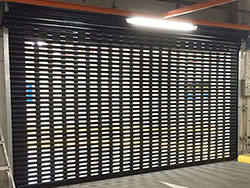


If an industrial roller shutter starts to close and then reopens or reverses direction, the cause may be an obstruction, damaged guide, incorrect limit setting, control fault or a problem with the shutter’s detection system.
The important thing is not to keep cycling the door repeatedly. If the shutter is reversing because it is meeting resistance or receiving an incorrect signal, repeated operation can place extra strain on the motor, guides and curtain.
For warehouses, factories, loading areas and strata car parks, this type of fault can quickly interrupt normal access and should be investigated before it develops into a larger problem.
Why Does a Roller Shutter Reverse While Closing?
A motorised industrial roller shutter may reverse because the control system believes something is preventing the shutter from closing correctly.
Depending on the shutter system, possible causes can include:
- an object in the opening
- debris in the guides
- damaged or misaligned guide rails
- curtain resistance
- incorrect travel limits
- detection sensor faults
- control system problems
- motor overload
- electrical faults
The exact cause depends on the shutter and its operating system.
Check for an Obvious Obstruction
The first thing to check is whether there is anything visibly obstructing the opening or guides.
Packaging material, pallets, dirt or other debris can interfere with the shutter’s movement.
Only remove an obstruction if it can be done without touching moving components or interfering with the shutter mechanism.
If nothing obvious is blocking the shutter, stop operating it and have the system inspected.
Damaged Guides Can Cause the Shutter to Reverse
The guides keep the shutter curtain aligned as it travels.
If a guide becomes bent or damaged, the curtain may begin to bind. This extra resistance can cause the shutter to stop or reverse.
Guide damage can occur after:
- forklift impact
- vehicle contact
- pallet damage
- repeated curtain misalignment
- general wear
Even a relatively small change in guide alignment can affect how smoothly the curtain travels.
Could the Travel Limits Be Incorrect?
Motorised roller shutters use limit settings to determine where the shutter stops when fully open and fully closed.
If these limits are incorrectly set, the motor may attempt to drive the shutter farther than it should.
This can result in:
- premature stopping
- incomplete closing
- repeated reversing
- unnecessary motor strain
- irregular operation
Limit settings may need to be checked after motor replacement, control work or other adjustments to the shutter.
Detection and Control System Faults
Some industrial roller shutter systems use sensors or other detection devices as part of their operating controls.
If a sensor is dirty, damaged, misaligned or sending an incorrect signal, the shutter may respond by stopping or reversing.
Control faults can also cause intermittent behaviour where the shutter works normally at some times but reverses unexpectedly at others.
These faults need to be diagnosed according to the specific shutter and control system rather than simply resetting the door repeatedly.
Is the Motor Causing the Problem?
Possibly, but the motor is not always the underlying cause.
A motor may stop or reverse because it is experiencing excessive load from another problem, such as:
- damaged guides
- a poorly aligned curtain
- excessive friction
- poor shutter balance
- damaged slats
Replacing a motor without correcting the mechanical cause can result in the same problem returning.
This is why the whole shutter should be checked when repeated reversing occurs.
Why Repeated Cycling Can Make the Problem Worse
It can be tempting to keep pressing the control until the shutter finally closes.
That can make matters worse.
Repeated operation can increase strain on:
- the motor
- curtain
- guides
- controls
- operating components
If the shutter repeatedly reverses, stops or behaves differently from normal, further operation should be limited until the fault is identified.
When Should the Shutter Be Professionally Inspected?
Arrange an inspection if:
- the shutter repeatedly reverses while closing
- it stops at the same point every time
- the curtain looks uneven
- guides are visibly damaged
- the motor sounds strained
- the shutter closes normally only occasionally
- controls respond unpredictably
- the fault keeps returning after a reset
A technician can check the shutter movement, guides, curtain, motor, controls and limit settings to identify the actual cause.
Can Regular Servicing Help Prevent This?
Yes.
Regular servicing can identify guide wear, curtain alignment problems, motor strain and control issues before they cause repeated operating faults.
For industrial shutters used frequently throughout the day, early attention to these issues can reduce disruption and help extend the life of the system.
Summary
An industrial roller shutter that repeatedly reopens or reverses may be reacting to an obstruction, damaged guides, curtain resistance, incorrect limits, control problems or excessive motor load.
Check only for obvious visible obstructions. If the shutter continues to reverse or does not operate normally, stop repeatedly cycling it and arrange an inspection.
The fault should be diagnosed across the complete shutter system rather than assuming the motor alone is responsible.
Why does my roller shutter close and then open again?
The shutter may be detecting resistance, an obstruction or an incorrect control signal. Damaged guides, incorrect limits and sensor or control faults can also cause reversing.
The shutter may be detecting resistance, an obstruction or an incorrect control signal. Damaged guides, incorrect limits and sensor or control faults can also cause reversing.
Yes. Bent or misaligned guides can create resistance as the curtain moves, which may cause the shutter to stop or reverse.
Should I keep resetting a roller shutter that keeps reversing?
No. If the fault keeps returning, repeated resetting does not address the underlying cause. The shutter should be inspected.
