




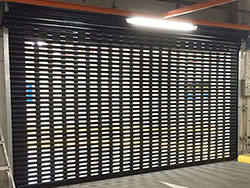


Industrial roller shutter weight is usually estimated from the size of the shutter curtain and the weight of the material used, then adjusted for components such as the bottom rail, barrel, guides and fittings.
A simple starting point is:
Shutter curtain area × material weight per square metre = approximate curtain weight
However, the full shutter assembly weighs more than the curtain alone. For industrial applications, accurate weight matters because it affects motor selection, spring balance, guides, fixings and structural support.
What Factors Affect Industrial Roller Shutter Weight?
The main factors are:
- shutter width
- shutter height
- material
- slat profile
- material thickness
- bottom rail
- locking hardware
- barrel assembly
- guides
- motor and operating equipment
Two shutters with the same dimensions can have very different weights depending on how they are constructed.
How Do You Calculate the Curtain Area?
The first step is to calculate the area of the shutter curtain.
For example, a shutter that is 5 metres wide and 4 metres high has an opening area of:
5 m × 4 m = 20 m²
If the selected shutter curtain weighs 10 kg per square metre, the approximate curtain weight would be:
20 m² × 10 kg = 200 kg
That is only the curtain weight. The complete shutter assembly will include additional components.
Why Material Makes a Difference
The material used in the shutter curtain has a major effect on weight.
Steel shutters are generally heavier than aluminium shutters of a similar size. Aluminium may be selected where lower curtain weight, corrosion resistance or smoother operation is important.
Steel may be more suitable for heavier industrial applications where a more robust curtain is required.
The correct material depends on the opening, operating conditions and expected workload.
How Does Slat Thickness Affect Weight?
Thicker material usually increases shutter weight.
Industrial roller shutters may use different slat profiles and gauges depending on the size of the opening and the performance required.
A larger shutter may need a stronger curtain profile, which can increase total weight significantly.
This affects not only the curtain itself but also the motor, guides, shaft and support structure.
Why Is Accurate Roller Shutter Weight Important?
Weight affects almost every part of the shutter system.
An incorrect weight estimate can result in:
- an undersized motor
- poor spring balance
- excessive load on the barrel
- increased wear on guides
- poor operation
- premature component failure
- unnecessary strain on the supporting structure
For motorised industrial shutters, the motor must be selected according to both shutter weight and expected operating frequency.
How Does Weight Affect Motor Selection?
Motor selection is not based on opening size alone.
The motor needs to be capable of moving the shutter curtain reliably, taking into account:
- total shutter weight
- balance of the shutter
- frequency of operation
- opening height
- type of controls
- site conditions
A motor that is too small may overheat or fail prematurely.
A motor that is unnecessarily large may add cost without improving performance.
The goal is to match the motor correctly to the shutter system.
How Does Shutter Weight Affect the Guides and Structure?
As shutter size and weight increase, guide and structural requirements also become more important.
The shutter guides keep the curtain aligned while it moves. Larger or heavier shutters may require stronger guides, fixings and support.
The structure surrounding the opening also needs to be suitable for the loads created by the shutter assembly.
This is particularly important for large industrial openings such as warehouses, factories and loading bays.
Can You Calculate Roller Shutter Weight From Size Alone?
Not accurately.
Size gives an indication, but material weight, slat profile, thickness and components also need to be considered.
Two 5-metre-wide shutters may have very different weights if one is aluminium and the other uses a heavier steel curtain.
For this reason, final calculations should be based on the actual shutter specification rather than a generic formula alone.
Why Weight Matters During Replacement
If an existing shutter is being replaced, the new curtain may not weigh the same as the old one.
Changing the material, profile or construction can affect:
- motor requirements
- spring balance
- barrel suitability
- guide loads
- structural loads
A replacement shutter should therefore be assessed as a complete system rather than assuming the existing operating equipment will automatically suit the new curtain.
Summary
Industrial roller shutter weight is generally estimated from the shutter area and material weight, then adjusted for components such as the bottom rail, barrel, guides and operating equipment.
Accurate weight is important because it affects motor selection, balance, structural support and long-term operation.
For industrial shutters, the final weight should be based on the actual shutter specification rather than opening dimensions alone.
How do you calculate roller shutter weight?
A basic estimate is calculated by multiplying the shutter curtain area by the material weight per square metre. Additional components then need to be included.
Does shutter material affect weight?
Yes. Steel shutters are generally heavier than aluminium shutters of a similar size, although the exact weight depends on the profile and thickness used.
Can an industrial roller shutter be too heavy for its motor?
Yes. If the motor is not correctly matched to the shutter weight and duty cycle, it may struggle, overheat or fail prematurely.
