




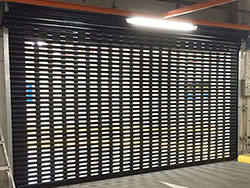


Industrial cyclone shutters commonly provide around 10–20 years of service when correctly designed, installed and maintained, although some systems may last longer. This is an industry estimate only, not a guaranteed Australian standard or manufacturer warranty. The actual lifespan depends on the product, design loads, exposure, corrosion protection, operating cycles, installation quality and maintenance.
The shutter curtain, guides and supporting structure can have different service lives. Motors, controls, seals, guides and fixings may require repair or replacement before the main shutter curtain. Severe storm damage, coastal exposure, corrosion, poor installation and high operating cycles can substantially reduce service life.
For cyclone-exposed industrial openings, the shutter must be selected for the site and building conditions, not simply because it is marketed as a “cyclone shutter”.
What Is an Industrial Cyclone Shutter?
An industrial cyclone shutter is a shutter system used on exposed openings where wind, storm and severe-weather performance may be required.
Cyclone shutters may also be described as storm shutters or hurricane shutters in some markets. These terms can be useful for search and product comparison, but they do not automatically prove certified performance.
A product’s claimed rating is only meaningful when the complete installed system matches the tested or engineered configuration. This includes the shutter curtain, guides, fixings, supporting structure, opening size, installation method and any motor or control system.
“Cyclone Shutter” Is Not a Compliance Guarantee
The phrase “cyclone shutter” should not be treated as proof that a shutter is suitable for every cyclone-exposed opening.
For an industrial opening, the designer or relevant professional should confirm the applicable wind region, terrain, shielding, building geometry, opening size, design pressures, fixing capacity and supporting structure.
AS/NZS 1170.2:2021 sets out wind actions for structural design in Australia and New Zealand, and Standards Australia describes it as the Wind Actions standard. The NCC also contains requirements for the design of buildings in cyclonic areas and refers to AS/NZS 1170.2 for wind pressures.
This means the shutter should be selected for the building and opening, not just chosen from a product name.
What Affects the Lifespan of Industrial Cyclone Shutters?
1. Design Wind Actions
Cyclone-exposed openings need to be considered against the relevant design wind actions for the building.
The suitable shutter system may depend on:
- wind region
- terrain category
- shielding
- topography
- building height
- building geometry
- opening size
- design pressures
- fixing capacity
- supporting wall or frame structure
A shutter that is suitable for one exposed opening may not be suitable for another.
2. Wind Resistance, Debris Impact and Water Resistance
Wind resistance, debris impact resistance and water resistance are separate performance issues.
Depending on its design and certification, a cyclone shutter may help resist wind pressures and, where specifically tested or engineered, impact from wind-borne debris. It should not be assumed that a wind-rated shutter is also debris-rated.
Australian emergency-management guidance notes that tropical cyclones can generate wind-borne debris capable of breaking windows and glass doors, but that does not mean every shutter provides debris-impact protection.
A cyclone shutter should not be described as a waterproof barrier unless the complete shutter, seals, surrounding construction and drainage system have been specifically designed and tested for water resistance.
Material, Coating and Corrosion Protection
Aluminium and steel are both used in shutter systems, but the appropriate material, coating, fasteners and detailing depend on design loads, corrosion exposure, opening size and the manufacturer’s system.
Aluminium does not rust like steel, but it can corrode, particularly in marine, industrial or contaminated environments. Contact between dissimilar metals can also create galvanic-corrosion risks.
Steel can provide high strength, but it needs a suitable coating system and regular maintenance in corrosive or exposed environments.
Coastal and industrial environments may require enhanced corrosion protection and more frequent cleaning or inspection.
Installation Quality
Installation quality has a major effect on shutter life.
A cyclone shutter needs to be installed to match the tested or engineered system. Poor installation can reduce performance and shorten the life of the shutter.
Installation issues may include:
- unsuitable fixings
- weak supporting structure
- poor guide alignment
- incorrect motor setup
- inadequate side or head fixing
- wrong shutter for the opening
- poor drainage or sill detailing
- failure to follow manufacturer instructions
For industrial sites, the surrounding structure is just as important as the shutter itself.
Operating Cycles and Daily Use
Some cyclone shutters may only be operated before severe weather. Others may be used regularly for access, sun control, weather protection or site management.
The more often a shutter operates, the more wear occurs on guides, motors, controls, brackets, fixings and moving parts.
High-use industrial shutters may need more frequent servicing than shutters used only occasionally.
Motors, Controls and Electrical Components
Motors, controls and electrical components may not last as long as the shutter curtain.
Motor lifespan can be affected by:
- shutter weight
- operating frequency
- poor alignment
- corrosion
- moisture exposure
- power supply issues
- incorrect motor sizing
- lack of servicing
- damaged guides or curtain sections
If a motor strains, stops partway, responds inconsistently or makes unusual noise, the full shutter system should be checked.
Weather and Storm Damage
Severe weather can shorten the life of cyclone shutters.
After significant wind, rain, impact or storm events, shutters should be inspected for:
- damaged slats
- bent guides
- loose fixings
- motor or control faults
- poor closure
- damaged seals
- corrosion
- obstruction in the tracks
- movement in the supporting frame
Even if the shutter still operates, storm or impact damage can reduce future reliability.
Are Storm Shutters Waterproof?
Storm shutters and cyclone shutters are usually better described as weather-resistant rather than fully waterproof.
Water can enter through or around an opening depending on:
- shutter design
- sill detail
- guide condition
- headbox design
- seals
- drainage
- wind direction
- surrounding wall construction
- floor levels
- weather severity
Many roller shutters are not intended to form a watertight barrier at the sill, guides, headbox or adjoining wall.
Operational Safety Warning
Do not force a jammed shutter, bypass controls or work on springs, motors, electrical components or suspended curtains without appropriate training.
Industrial shutters can be heavy and may store mechanical energy. If a shutter is jammed, damaged, unreliable or not responding properly, isolate the system where appropriate and arrange inspection by a suitably qualified technician.
Where electrical, motor, control or safety-device faults are suspected, arrange testing by a competent technician.
Maintenance to Extend Service Life
Maintenance helps extend the life of an industrial cyclone shutter by keeping the system clean, aligned and operational.
Maintenance may include checking:
- guides and tracks
- curtain condition
- fixings
- supporting structure
- motor operation
- controls
- corrosion
- seals
- bottom rail
- signs of impact damage
- movement through a full cycle
- manual override where fitted
For cyclone-exposed sites, arrange checks before the locally relevant cyclone or severe-weather season and after any significant storm or impact event.
Signs It Is Time to Repair or Replace Cyclone Shutters
An industrial cyclone shutter may need repair or replacement if it:
- is hard to open or close
- does not close fully
- has damaged slats
- has bent guides
- shows corrosion
- has loose or damaged fixings
- has unreliable motors
- has damaged seals
- has suffered storm or impact damage
- no longer suits the opening
- no longer matches the required performance for the site
Repair may be suitable if the main system is sound. Replacement may be better if the shutter is badly damaged, unreliable, corroded or no longer suitable for the building.
Are Cyclone Shutters Expensive?
Cyclone shutter cost depends on opening size, material, performance requirements, motorisation, installation access, supporting structure, corrosion protection and site exposure.
A larger industrial opening will usually cost more than a smaller shutter because it may need stronger components, more material and a system suited to the design wind actions.
The best value comes from choosing a shutter that is suited to the building and maintained correctly.
Summary
Industrial cyclone shutters commonly provide around 10–20 years of service when correctly designed, installed and maintained, although this is only an industry estimate and not a guaranteed lifespan. The actual result depends on design wind actions, product materials, corrosion exposure, installation quality, operating cycles, maintenance and storm or impact damage. A shutter marketed as a cyclone shutter is not automatically suitable for every cyclone-exposed opening. Wind resistance, debris-impact resistance and water resistance should be confirmed separately from the manufacturer’s technical documentation and the project’s design requirements.
Common Questions
How long do industrial cyclone shutters last?
A well-designed and maintained industrial cyclone shutter may provide around 10–20 years of service, and sometimes longer. Motors, controls, seals and fixings may need attention sooner.
Is a cyclone shutter automatically certified for cyclonic conditions?
No. The complete installed system must match the tested or engineered configuration for the specific opening and design requirements.
Are storm shutters waterproof?
Usually no. They are generally weather-resistant rather than fully waterproof unless the complete shutter, seals, surrounding construction and drainage have been designed and tested for water resistance.
What are cyclone shutters made of?
They may use aluminium, steel or other specialised materials depending on the manufacturer’s system and the required performance.
