




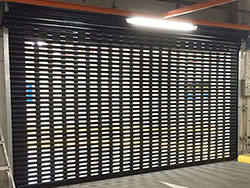


A fire curtain and a fire shutter are both designed to help control the spread of fire, but they are different systems and are not interchangeable.
A fire curtain is generally a flexible barrier that deploys when required, while a fire shutter is a rigid rolling closure designed to protect an opening in fire-resisting construction. The correct choice depends on the building design, the opening, the required fire performance and the approved fire strategy.
For industrial and commercial buildings, the important point is that neither system should be selected simply by appearance. It needs to be the correct tested and approved system for the particular application.
What Is a Fire Curtain?
A fire curtain is a flexible barrier designed to deploy when required as part of a building’s fire-protection strategy.
Depending on the system, a fire curtain may descend from a concealed headbox and form a barrier across an opening. These systems are often used where a rigid shutter would not suit the design or where a more discreet solution is required.
Fire curtains may be used in applications such as:
- open-plan building areas
- atriums
- large internal openings
- some commercial buildings
- specialist architectural applications
The exact performance of a fire curtain depends on the tested system and the requirements of the approved building design.
It is important not to assume that every fire curtain performs in the same way. Fire resistance, smoke control, operating method and allowable dimensions can vary between systems.
What Is a Fire Shutter?
A fire shutter is a rolling shutter specifically designed and tested for use where an opening needs fire-resisting protection.
It usually consists of a metal curtain, guides, barrel or roller mechanism and a closing system.
Under the National Construction Code, a required fire shutter must meet specific fire-performance requirements. NCC Specification 12 states that a required fire shutter must either be identical to a tested prototype that achieved the required FRL and be installed within the tested limitations, or, where permitted, be a steel shutter complying with AS 1905.2.
This is why an ordinary steel roller shutter should never be assumed to be fire rated simply because it is made from steel.
Fire Curtain vs Fire Shutter: The Main Differences
The biggest difference is the way the two systems are constructed and how they are used.
A fire curtain is generally flexible and designed to deploy from a concealed or compact housing.
A fire shutter is a more rigid rolling closure that travels within guides and protects a defined opening.
Other differences can include:
- material and construction
- size and type of opening
- installation method
- operating mechanism
- tested fire performance
- smoke-control capability
- architectural impact
- maintenance requirements
The correct system depends on the building’s approved design rather than a simple preference for one over the other.
Is a Fire Shutter Better Than a Fire Curtain?
Not necessarily.
A fire shutter may be better suited to an industrial opening where a robust rolling closure is appropriate.
A fire curtain may be better suited to an internal architectural opening or an area where a concealed barrier is preferred.
Neither should be described as universally better.
The relevant question is:
Which tested system satisfies the required fire performance for this opening and building?
That depends on factors such as:
- required FRL
- building classification
- opening dimensions
- approved fire-engineering documentation
- structural conditions
- smoke-control requirements
- how the opening is used
- state or territory requirements
How Do Fire Shutters Operate?
Fire shutters may be designed to close automatically when the relevant fire-detection or alarm system is activated.
For certain protected openings, the NCC requires automatic closing to be initiated by smoke detection or another suitable detector, and may also require activation from other fire alarm systems within the building.
The exact operating arrangement depends on the tested shutter system and the approved building design.
Fire shutters may use:
- motorised closing systems
- controlled release systems
- gravity-assisted closing
- alarm interfaces
- other tested activation arrangements
The specific mechanism should always match the approved installation.
How Do Fire Curtains Operate?
Fire curtains also generally deploy when triggered by the building’s fire-protection system.
Depending on the design, the curtain may descend automatically to form a barrier across the opening.
However, the way a fire curtain operates depends on the specific product and its tested configuration. Some systems are designed primarily for fire separation, while others may also provide smoke-control functions.
The installation needs to match the approved fire strategy for the building.
Are Fire Curtains and Fire Shutters Fire Rated?
They can be, but only where the specific system has been tested and approved for the required performance.
For fire shutters, the NCC specifically references tested prototypes and AS 1905.2 for certain steel fire shutters.
Fire performance is generally expressed using an FRL or another specified performance requirement rather than simply describing a product as “fireproof”.
The rating of one product cannot automatically be transferred to another installation.
Factors such as opening size, guides, fixings, surrounding construction and installation method can all affect whether the tested performance applies.
Can a Normal Roller Shutter Be Used as a Fire Shutter?
No, not simply because it is steel or heavy duty.
A standard industrial roller shutter may be suitable for everyday access control, weather protection or operational use, but that does not make it a compliant fire shutter.
A fire shutter must be a system specifically designed, tested and installed for the required fire-resistance application.
This distinction is important when replacing an existing shutter or modifying an opening in a fire-rated wall.
Where Are Fire Shutters Commonly Used?
Fire shutters may be used where a protected opening is required within fire-resisting construction.
Examples can include certain:
- warehouse openings
- industrial buildings
- service areas
- commercial buildings
- internal fire-compartment openings
However, these are examples only.
A fire shutter is not automatically required just because a building is industrial or commercial. The requirement depends on the NCC, the building design and the approved fire documentation for the site.
Which One Should You Choose?
The choice between a fire curtain and a fire shutter should be based on the building requirements rather than price or appearance alone.
Before specifying either system, the project team should confirm:
- the required fire performance
- the approved fire-engineering design
- the size of the opening
- whether smoke control is required
- how the opening is used
- whether the system must integrate with alarms or controls
- the maintenance requirements
- the applicable NCC and state or territory provisions
For industrial applications where a fire shutter is being considered, the shutter should be selected and installed as a complete tested system.
Summary
Fire curtains and fire shutters both help protect openings during a fire, but they work in different ways.
A fire curtain is generally a flexible barrier that deploys across an opening, while a fire shutter is a rigid rolling closure that operates within guides.
Neither system is automatically better. The correct choice depends on the required fire performance, the type of opening and the approved building design.
Most importantly, a standard roller shutter should not be assumed to be fire rated. A fire shutter must be the correct tested and approved system for the application.
What is the main difference between a fire curtain and a fire shutter?
A fire curtain is generally a flexible barrier, while a fire shutter is a rigid rolling closure that moves within guides.
Is a fire shutter the same as a normal roller shutter?
No. A standard roller shutter is not automatically fire rated. A fire shutter must be designed, tested and installed for the required fire-resistance application.
Is a fire curtain better than a fire shutter?
Not necessarily. The correct system depends on the building design, opening, fire-performance requirements and approved fire strategy.
What standard applies to fire shutters in Australia?
The NCC sets requirements for fire shutters, and certain steel fire shutters may need to comply with AS 1905.2 where that pathway is permitted. Tested fire-shutter systems may also rely on fire-resistance testing such as AS 1530.4.
